


When you’re new to Christianity, it can feel like stepping into a whole new world. There’s so much to learn, so many questions to ask, and a lot of voices telling you where to start. About a year and a half ago, Anthony and I decided to fully recommit our lives to God, and that decision changed everything. Our priorities shifted and we started to experience what it really means to walk with Him day by day.
I had always believed in God from when I was little and knew the basics of the Christian faith, but I realized I wasn’t truly living it. When we had little ones, it hit me that I wanted them to know the Bible, but I didn’t really know it myself. That conviction led me to start reading Scripture every day. I grew up going to church, but I had never really opened my Bible on my own, and once I did, it completely transformed my faith. It brought peace, clarity, and a real desire to know God personally, not just know about Him.
Around that time, I also started reading apologetics, which helped me understand the why behind what I believe and gave me even more confidence in God’s Word.
Before diving into the resources or where to start reading the Bible, I want to first share what it really means to be a Christian, so there’s clarity on what the Gospel actually is. I love how my pastor outlines the main points below:
WHAT IS THE GOSPEL?
Good news. At the heart of it, the Gospel means “good news.” It’s good news because of the very bad news of man’s sinfulness and inability to change himself. It’s good because it’s about God, who is completely good in His character, doing the best act of goodness that has ever been done. In fact, God is where we need to start in order to get a full picture of this good news.
God is the Holy Creator
There is only one true God (Deuteronomy 6:4; 1 Samuel 2:2; 2 Samuel 7:22; 1 Kings 8:23). The word we use to describe God’s distinction from everyone and everything else is holy (Isaiah 6:3). When the Bible says God is holy, it means He is unique. He is completely different from us. God’s holiness is also connected to His separation from sin. James 1:13 says that God “cannot be tempted with evil.” Titus 1:2 and Numbers 23:19 both state that it is impossible for God to lie, and Habakkuk 1:13 says that God’s eyes are purer than to even see sin or look at wrong. God is perfect in all His character and in all His ways. He is without flaws, fault, sin, or imperfection of any kind. God is holy.
The God of the good news is not only holy, He is also the one who created you and me and everything else in our world (John 1:3; Colossians 1:16). The Bible’s very first words are, “In the beginning God created the heavens and the earth” (Genesis 1:1). Genesis goes on to detail how God made our entire universe out of nothing, using just His words, in six days before resting on the seventh. While all of God’s creation was amazing, He uniquely made humans in His image. He formed the first man, Adam, out of the ground and then made Eve out of one of Adam’s ribs.
Psalm 96:5 emphasizes the importance of recognizing God as the creator: “For all the gods of the peoples are worthless idols, but the LORD made the heavens.” First Chronicles 16:26 makes the same point almost verbatim. When Paul began preaching the Gospel in Athens, he began by describing God as the one who made the world and everything in it, which makes Him the Lord of heaven and earth (Acts 17:22–24; Revelation 4:11). The reason it is crucial to the Gospel to recognize God as Creator is that it puts Him over us. God has the right to rule over us and our world because He made it (Romans 13:1). And after each day of creation, Genesis records that God saw that each day of creation was good. When He was done creating, God said it was “very good” (Genesis 1:31).
So what went wrong? How did we go from a perfect creation that was very good to the mess of the world we have now?
Man is Totally Sinful
Genesis 3 records how Adam and Eve sinned and plunged all of humanity into sin. God had given them just one prohibition in their perfect paradise. They could eat from any tree in the garden, except for the tree of the knowledge of good and evil. God warned them that on the day they ate from that tree they would die. In Genesis 3:1–5, Satan came to Eve in the form of a snake and accused God of lying and of keeping something good from Adam and Eve. Eve was tricked into believing Satan and ate from the tree, and then Adam chose to eat from it too. In that moment, all that was perfect in God’s creation was shattered. God put a curse on all of His creation, from the ground to Adam and Eve to the snake. Sin had entered the world, and nothing would remain unstained by it.
Adam and Eve’s sin was not just a distant event for you and me, however. Its direct result for us is that now we are guilty as sinners too. Romans 5:12 says, “Therefore, just as sin came into the world through one man, and death through sin, and so death spread to all men because all sinned.” Romans 3:10–12 paints a bleak picture of who we really are:
as it is written:
“None is righteous, no, not one;
no one understands; no one seeks for God.
All have turned aside; together they have become worthless; no one does good, not even one.”
Romans 3:23 clearly tells us that “all have sinned and fall short of the glory of God.” Sin is breaking God’s commands (1 John 3:4). It’s doing what He says not to do, or failing to do what He says we should (Luke 10:27–37). And all of us have done it. There is not a single human alive who has not sinned. Even if we sinned only once, James 2:10 says we would be guilty of all. Once we break God’s commands even one time, we are permanently lawbreakers. The standard is God’s holy, sinless perfection (Matthew 5:48).
And this is an immense problem because God is the Holy Creator. As Creator, God has the right to tell his creation what to do, and because He is holy, God cannot allow sin in His presence or for sin to go unpunished (Nahum 1:3). Romans 6:23 soberingly tells us that the punishment, or the “wages,” of sin is death (Ezekiel 18:4). We will all die, and after that we will all face judgment before the holy and righteous Judge (Hebrews 9:27; 1 Corinthians 6:9). To compound our problems, we cannot get rid of sin on our own. Even the righteous things we try to do are no better than filthy rags to God (Isaiah 64:6). Even if we tried to obey God’s law, we couldn’t get rid of our sins because “by works of the law no human being will be justified in his sight” (Romans 3:20).
So if we all have sinned, and God punishes all sin, and we can’t get rid of our own sin, where’s the good news?
Jesus lived a perfect life, died a substitutionary death, and rose victoriously from the dead.
The good news is that Jesus did for you what you could never do for yourself. He lived perfectly, never committing a single sin, before He died on a cross. First Peter 2:22 and 23 says, “He committed no sin, neither was deceit found in His mouth. When He was reviled, He did not revile in return; when He suffered, He did not threaten, but continued entrusting Himself to Him who judges justly.” Peter had already described Jesus in 1:19 as a lamb “without blemish or spot.” Jesus was perfect because He was fully God and fully man. God has eternally existed as Father, Son, and Holy Spirit, and God’s plan of salvation was always for the Son to come to earth as a baby and then live out a life of perfect holiness. Jesus is the Christ, the Messiah who God promised would rescue his people (John 20:31; Matthew 16:16; 1 John 3:23; 1 John 5:1).
Why did Jesus die if He had never sinned? It wasn’t because He had sinned, but because He was taking our place. First Peter 2:24 goes on to say, “He himself bore our sins in His body on the tree, that we might die to sin and live to righteousness. By His wounds you have been healed.” Second Corinthians 5:21 says, “For our sake He (God) made Him (Jesus) to be sin who knew no sin, so that in Him we might become the righteousness of God.” Jesus’ sacrificial death was to take the punishment we all deserved (Colossians 2:13–14).
The good news would not be good, however, if Jesus had merely died. Had He stayed dead, there would be no Christianity. If Jesus didn’t come back from the dead, the apostles’ preaching would be empty, our faith would be empty, we would still be in our sins, those who have already died would be eternally dead, and Christians would be the most pitiful people on the planet (1 Corinthians 15:12–19). “But in fact, Christ has been raised from the dead” (1 Corinthians 15:20).
Paul’s summary of the Gospel in 1 Corinthians 15:1–5 is, “Now I would remind you, brothers, of the gospel I preached to you, which you received, in which you stand, and by which you are being saved, if you hold fast to the word I preached to you—unless you believed in vain. For I delivered to you as of first importance what I also received: that Christ died for our sins in accordance with the Scriptures, that He was buried, that He was raised on the third day in accordance with the Scriptures, and that He appeared to Cephas, then to the twelve.”
How does Jesus’ life, death, and resurrection affect you, though? The good news of Jesus’ life, death, and resurrection comes with an implicit command to you.
You must repent and believe
The Gospel calls you to respond, and that response ought to include repentance and belief. Repentance and belief are two separate actions, but they are two sides of the same coin.
Repentance means “to turn away from sin”, while belief describes us turning to God. Jesus preached repentance regularly (Matthew 4:17; Luke 13:3, 5). At the conclusion of Peter’s sermon on the day the church began, he commanded those who were responding to his message to “repent and be baptized” (Acts 2:38). Paul summarized his missionary work as declaring all across the known world that all people should repent and turn to God (Acts 26:20).
Repentance is more than grief over sin (2 Corinthians 7:10). The Gospel does not allow us to say we will embrace our sin and Jesus. While Jesus does not demand that we be sinless, He does demand that we willingly turn from sin to Him. Paul complimented the Thessalonians because they turned from idols to serve the living and true God (1 Thessalonians 1:9).
While repentance is a necessary part of responding to the Gospel, we must be careful to see it as part of belief. All of us as humans are prone to want to work for our salvation. We want to earn God’s favor, or try to balance out the scales of our good and bad, or at the very least feel like we are contributing to our salvation. But the biblical Gospel is that we are saved by grace, through faith alone in Christ alone.
Ephesians 2:4–9 says:
“But God, being rich in mercy, because of the great love with which He loved us, even when we were dead in our trespasses, made us alive together with Christ - by grace you have been saved - and raised us up with Him and seated us with Him in the heavenly places in Christ Jesus, so that in the coming ages He might show the immeasurable riches of His grace in kindness toward us in Christ Jesus. For by grace you have been saved through faith. And this is not your own doing; it is the gift of God, not a result of works, so that no one may boast.”
When a scared, awed Philippian jailer came to Paul and Silas at midnight and asked how he could be saved, they replied, “Believe in the Lord Jesus Christ” (Acts 16:30, 31). And while the wages of sin is death, the gift of God is eternal life (Romans 6:23). Gifts are not things you work for or earn, or else they aren’t gifts.
Salvation comes to those who put their trust, their belief, in Jesus, not in their own actions or goodness. “God so loved the world that He gave His only Son, that whoever believes in Him should not perish but have eternal life.” (John 3:16).
The Gospel begins with God and, in the end, brings us back to God. The Holy Creator made the entire world good, but sin ruined man’s relationship to God and the goodness of this world. In His love, however, God planned to send His only Son, Jesus, to fix the sin problem we could never fix on our own. Jesus lived without ever sinning, died to take sinners’ punishment, and rose to conquer sin and death and Satan. The Good News is that you can be rescued from your sin simply by believing this wonderful message.
If you’re new to faith, this is where your walk with God begins. Understanding the Gospel (that Jesus died and rose again to save you) is the foundation. The next step is growing in your relationship with Him through Scripture, prayer, and community. Here are some resources I love that can help you build a strong foundation as you begin your walk with God:
Bible
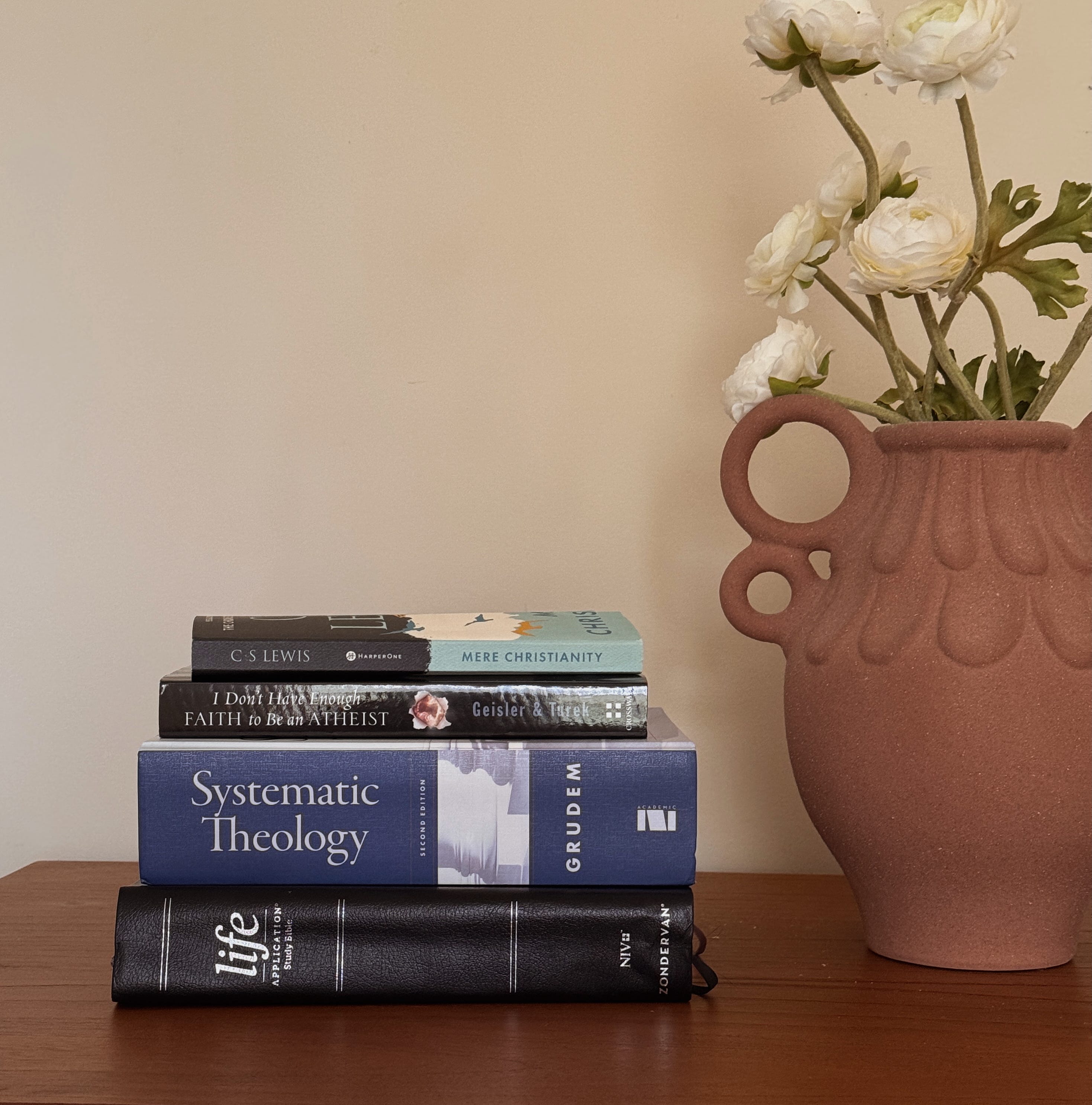
If you’re new to reading Scripture, start with a translation that’s accurate and clear. The ESV (English Standard Version) Study Bible or the NIV Life Application Study Bible are both great options.
Even though it’s convenient to read from your phone, I’ve found that using a physical Bible helps me stay focused and not be distracted by notifications coming in. I like being able to highlight verses and jot down notes as I read. Every morning I spend at least 15 minutes in Scripture, it’s become part of my routine, something I naturally do as I start the day. It clears my mind, centers my heart, and reminds me of my purpose before anything else. I use the Life Application Study Bible and really love the footnotes… they give helpful context to what I’m reading and offer practical ways to apply it to everyday life.
If you’re wondering where to begin, try:
John- shows us who Jesus truly is, the Son of God and the Savior of the world. His goal is that by reading, you would believe in Jesus and find eternal life through Him.
Luke- tells the story of Jesus’ life, death, and resurrection, showing that God’s salvation has come for everyone. It highlights His compassion for the lost, the outcasts, and those society overlooks.
Psalms- captures the full range of human emotion such as joy, fear, gratitude, sorrow, and hope, all directed toward God. It reminds us of His faithfulness and serves as a guide for honest prayer and heartfelt worship.
Proverbs- is filled with practical wisdom for everyday life. It teaches how to live with integrity, make wise choices, and honor God through the fear of the Lord, which means having deep respect, awe, and reverence for Him while recognizing His authority and truth.
Romans- lays out the foundation of the Christian faith. It clearly explains the gospel, that we are saved by grace through faith in Jesus Christ, not by our own works, and that this gift is available to everyone.
I love the Versify app to help me remember scripture as well. You plug in the verse you want to learn and it tests your memory by having you fill in the blanks.
I’m currently reading the book of Ezekiel and plan to continue reading forward from there. Anthony is doing the same, reading each book in order, he wanted to start in Genesis and keep going, so everyday he reads a little in order and now I think he’s almost to the New Testament. However you decide to read, make it a daily habit.
I love using these Bible tabs - they make it so easy to find each book, and just seeing them regularly has helped me memorize the order of the books too.
Podcasts
Dial In Podcast- The pastor at my church, Jonny Ardavanis, hosts this podcast, and I love how he shares his heart for helping people understand and live out God’s Word. As he says, “God’s Word has changed my life, and my passion is that people would understand and obey it. The truth of Scripture has the ability to renew our minds, give us joy, and transform us into the image of Christ.”
For The Gospel Podcast- For the Gospel Podcast provides sound doctrine for everyday people. By discussing practical topics, answering tough questions, and interviewing influential guests, we want to inspire you to live for the gospel of Jesus Christ.
The Alisa Childers Podcast- Helping you answer Progressive Christianity and skeptical claims against the gospel from a biblical worldview.
Books
I love reading apologetics, which simply means learning how to explain and defend the truth of the Christian faith. Studying apologetics strengthens my own faith and gives me confidence when questions come up, whether from others or in my own mind. It helps connect reason and belief, reminding me that faith in God is both intellectually sound and deeply personal.
Mere Christianity by C.S. Lewis- Originally a series of radio talks given during World War II, this classic lays out the core beliefs of the Christian faith in a clear and thoughtful way. Lewis explains Christianity with logic, reason, and warmth, making complex ideas simple to grasp. It’s a great place to start if you’re new to faith or want to understand what Christians believe and why.
The Case for Christ by Lee Strobel- Written by Lee Strobel, a Yale Law graduate and former legal journalist for The Chicago Tribune, this book follows his journey from skepticism to faith. As an atheist, he set out to investigate the evidence for Jesus’ life, death, and resurrection- using his background in journalism and law to examine the facts. What he discovered ultimately led him to believe. It reads like a true investigation and is easy to follow even if you’re new to faith.
I Don’t Have Enough Faith to Be an Atheist by Norman Geisler and Frank Turek- This book makes a powerful case for why Christianity is both rational and evidence-based. Geisler and Turek walk through history, science, and philosophy to show that it actually takes more faith to deny God’s existence than to believe in Him. It’s written clearly and builds step-by-step, starting with logical proofs for truth and moving all the way to the evidence for Jesus and the resurrection. It’s one of the best books for strengthening your confidence that faith and reason go hand in hand.
Doctrine: What Christians Should Believe by Mark Driscoll and Gerry Breshears- A clear, comprehensive overview of what Christians believe and why it matters. It breaks down big theological ideas, like sin, salvation, and grace, in a way that’s straightforward and rooted in Scripture.
Systematic Theology, Second Edition: An Introduction to Biblical Doctrine by Wayne Grudem
This is a great book to keep on hand when you want more clarity on specific areas of the Bible. It explains big biblical themes in a clear and structured way, helping you see how everything connects. I use it like a textbook, referencing it when I’m studying a topic or passage and want to understand what the Bible teaches about it as a whole.
Can I Trust the Bible? (Docuseries by Wes Huff)
Not a book, but a great series if you’ve ever wondered how we know the Bible is reliable and historically accurate. Wes Huff explains how Scripture was written, preserved, and verified over time in a way that’s easy to follow and deeply informative. It’s perfect for new believers who want to understand why we can have complete confidence in God’s Word.
Find a local church
Finding a local church is one of the most important steps you can take as a new believer. Look for a church that actually teaches from the Bible and keeps the focus on Jesus, not trends or opinions. Most churches have a what we believe section on their website, and it’s worth reading through. You want to see that they hold to Scripture as truth, teach repentance and grace clearly, and believe salvation comes through faith in Jesus alone.
When we first moved to Franklin, we visited a church that had amazing worship, but the sermons only pulled a verse here and there without really explaining the passage or giving much depth. I looked into the pastors and saw that none of them had formal theological training. The messages were rooted in Scripture, but they stayed surface-level and didn’t challenge us to dig deeper.
That experience taught me how important it is to find a church that truly walks through God’s Word with depth and clarity. Around that time, I started listening to the Dial In Podcast and later realized the pastor was local to us. We decided to visit, and right away we could tell it was different. Each week we walk through Scripture verse by verse, and I’ve learned more about God’s Word there than anywhere else. It’s helped me grow so much in my understanding of the Bible and how to live it out.
And once you find a church with sound teaching, commit to going each week. You’ll start to meet like-minded people, build real community, and find ways to serve, giving back your time and being part of what God is doing there.
Final thought
Choosing to follow Jesus is the most important decision you’ll ever make. It’s the start of a real relationship that changes everything. Walking with God brings a peace and purpose that nothing else in this world can offer.
Jesus said in Matthew 7:13–14, “Enter through the narrow gate. For wide is the gate and broad is the road that leads to destruction, and many enter through it. But small is the gate and narrow the road that leads to life, and only a few find it.” I want to be one of those few.
The narrow road isn’t the easy one, but it’s the path that leads to real and eternal life. It’s always easier to go with the flow, to live without conviction, or to follow whatever feels comfortable in the moment. But that’s the wide gate Jesus warns about… the easy, popular path of worldly pleasure and self-reliance that leads to destruction. Following Him might cost more, but it’s so worth it.
Your faith will grow the most in the hard seasons, when you realize that God is still steady and faithful even when life feels uncertain. Keep going and stay close to His Word. As you do, your faith will get stronger and more steady.
One verse I come back to often is Romans 12:12: “Be joyful in hope, patient in affliction, faithful in prayer.” It keeps me grounded and reminds me that real hope only comes from knowing God and trusting that He’s in control. When you belong to Him, you can face anything with peace because you know He’s sovereign over every part of your life, it’s not random chaos. As Corrie Ten Boom once said, “There’s no panic in heaven, only divine plans.” I love that reminder- nothing ever surprises God, and He’s always in control.
This verse also reminds me why I want to stay on the narrow path. It’s not the easy road, but it’s the one that leads to real life. There’s so much peace in knowing your name is written in the Book of Life. You don’t have to wonder what comes after this life because you know the truth. That kind of confidence doesn’t come from blind faith… it comes from both faith and evidence. The Bible has proven itself again and again through history and prophecy, and when you really study it, you see it’s the only truth that stands firm.
It’s an honor to walk with God and to know that what you believe is real. The more you learn, the more your faith grows, and the more you realize that following Jesus isn’t just the right path- it’s the only one that leads to lasting purpose and life that never ends.
Let me know in the comments if you’ve read any other great apologetic books that I should read next!
xx Brittany